
Khadijah bint Khuwaylid: First Mother of Believers
Discover the extraordinary life of Khadijah bint Khuwaylid, the first mother of the believers and wife of the Prophet Muhammad ﷺ. Learn about her pivotal role in early Islam and her legacy as the first to embrace his message.
Veil & Vision
10/29/20259 min read
Early Life and Character
Khadijah bint Khuwaylid (RA), the first wife of the Prophet Muhammad ﷺ, was a woman whose name would forever be written in the history of Islam. She holds nine noble distinctions: the first wife of the Prophet ﷺ, the first believer, the first Muslim, the first mother of the believers, the first to receive glad tidings of Jannah, the first to receive salaam from Allah, the first to receive salaam from Jibreel, the first to worship with the Prophet ﷺ, and the first to perform tawaf with the Prophet ﷺ.
Her full name is Umm Hind Khadijah bint Khuwaylid ibn Asad ibn ‘Abd al- ‘Uzza ibn Qusay, from the noble Banu Asad clan of the Quraysh tribe. She was born in 555 CE, fifteen years before the Prophet ﷺ, Khadijah grew up in a household full of honor, intellect, and prosperity. Her father, Khuwaylid ibn Asad, was a man of power and influence, known for his success in trade across Arabia and neighboring lands who entrusted her with his business long before his death. Her mother, Fatimah bint Zaa’idah, also came from a respected family.
From an early age, Khadijah displayed remarkable intelligence, grace, and moral integrity. Unlike most of her peers, she never worshiped idols, even before Islam, and was known among her people as At-Tahira, the Pure One, for her honesty, modesty, and integrity. She was beautiful, eloquent, noble and dignified, yet what truly set her apart was her humility. Despite her wealth and position, she never belittled anyone, never backbit, never lied, and never abused her influence. All that could have made her arrogant only increased her gentleness.
In her youth, she once dreamt that the moon descended into her home. Her cousin Waraqah ibn Nawfal, a wise and learned man who studied earlier scriptures, interpreted the dream as a sign that she would one day marry a noble man or a Prophet of Allah.
Businesswoman and the Generous Heart of Mecca
As a young woman, Khadijah married Abu Haalah ibn Zuraarah ibn An-Nabbaash, with whom she had two sons: Haalah and Hind. After his death, she later married Ateeq ibn ‘Aa’ith ibn ‘Umar ibn Makhzoom, and they had a daughter, Hind bint Ateeq, and a son, ‘Abd al- ‘Uzza. Both her husbands died while she was still young. By the age of twenty-five, Khadijah was widowed twice.
From her father and her two late husbands, she inherited significant wealth and property. Yet it was her intelligence, wisdom, and business acumen that transformed this inheritance into one of the most powerful trading businesses in Mecca. Her caravans, numbering over 800 camels, stretched across the Arabian Peninsula, traveling as far as Syria and Yemen. Her business alone equaled the combined trade of all Quraysh merchants.
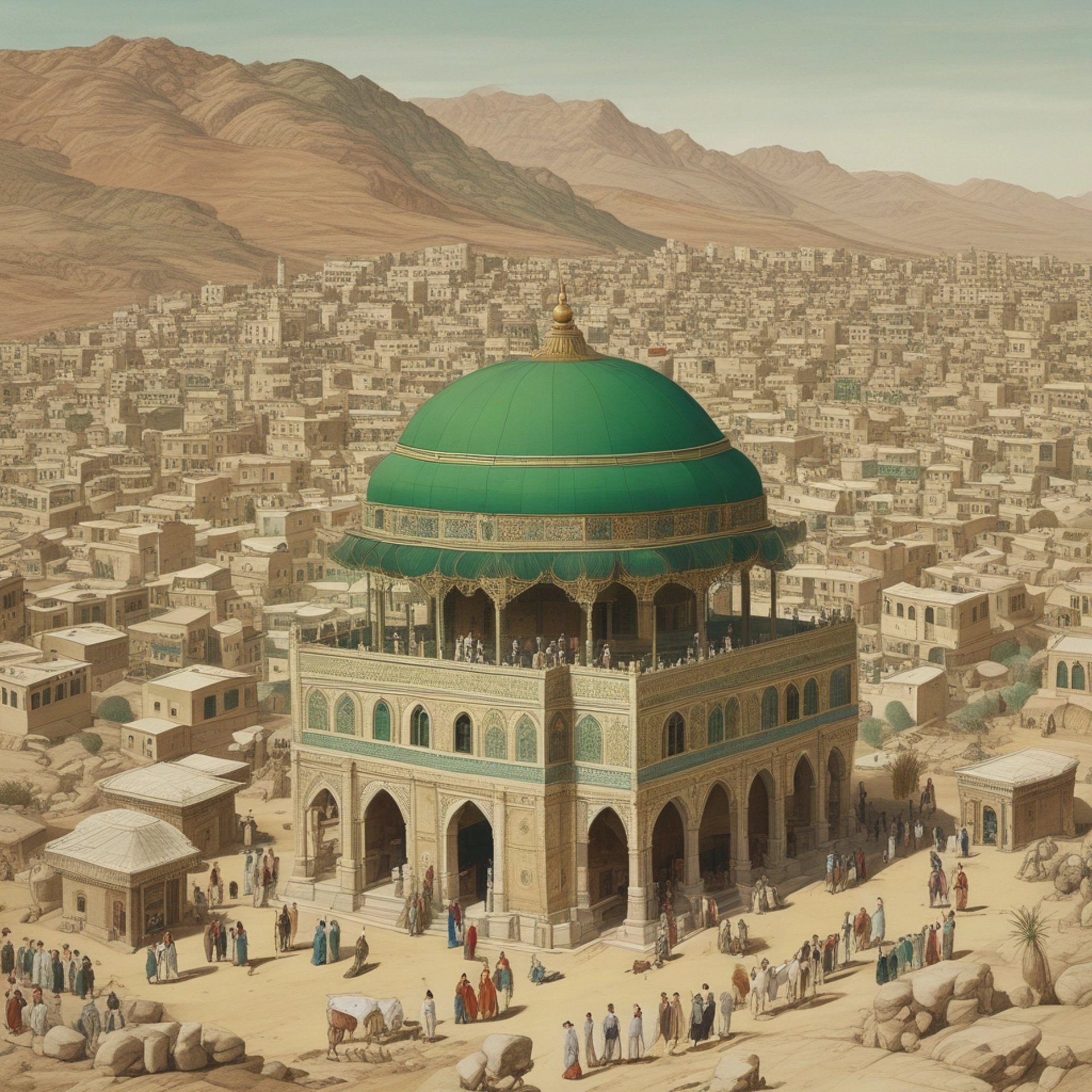
She was given titles such as Amirat Quraysh (Princess of Quraysh), Sayyidah Nisaa Quraysh (Leader of the Women of Quraysh), and Khadijah al-Kubra (Khadijah the Great), acknowledgments of her excellence, leadership, and character. But her wealth was never a barrier between her and the poor. Despite her prosperity, Khadijah’s home was a sanctuary for people in need. A green silk pavilion was raised over her house, not as a sign of luxury but as a symbol for those in need. It told the poor, widows, and orphans that her door was always open. She financed marriages for those unable to afford dowries, helped orphans, clothed the needy, supported the sick, and fed the hungry.
“... And whatever you spend in good, it will be fully repaid to you, and you will not be wronged.”
— Surah Al-Baqarah (2:272)
Her goodness made her a target for dishonest traders, who sometimes cheated her in business. But Khadijah (RA) never allowed such experiences to harden her heart. Instead, she began searching for someone honest. Someone trustworthy enough to handle her business with integrity.
The Meeting, the Marriage of “At-Tahira” and “Al-Amin” and Their Life Together
It was during this search that Khadijah (RA) first heard of a young man known as Muhammad ibn Abdullah, renowned in Mecca for his integrity and truthfulness. People called him Al-Amin, The Trustworthy. Through her sister Haalah, Khadijah learned that Muhammad ﷺ worked as a shepherd and was known for his honesty. She approached his uncle Abu Talib, asking if Muhammad ﷺ would lead one of her caravans to Syria. Abu Talib was initially hesitant, but after several requests, he agreed.
Khadijah sent the Prophet ﷺ on this journey with her servant Maysarah. During the trip, Maysarah observed the Prophet’s noble character, his fairness, and even miraculous signs that accompanied him. Upon their return, Maysarah reported that Muhammad ﷺ had not only conducted her trade with excellence, doubling her profits, but that he was unlike any man he had ever met: humble, kind, and devout. Khadijah was deeply moved by these reports.
Her close friend Nafisah noticed the admiration in Khadijah’s words when she spoke about Muhammad ﷺ and offered to act as a matchmaker. Nafisah went to the Prophet ﷺ and asked him why he had not married. He replied that he lacked the means. Nafisah then suggested: “What about a woman of wealth, beauty, character, and nobility?” When the Prophet ﷺ learned that this woman was Khadijah, he humbly asked, “How could she be interested in me, when she is the princess of Quraysh?”
Soon after, Khadijah sent a marriage proposal. The Prophet’s uncle, Abu Talib, accompanied him to her home, and their marriage was conducted in the presence of Waraqah ibn Nawfal, her cousin. She was forty; he was twenty-five. But theirs was not a union of convenience, it was a partnership built on faith, trust, and mutual respect. For many years, Khadijah had refused marriage proposals, even from Mecca’s most powerful men, such as Abu Jahl, Abu Sufyan, and Uqbah ibn Abi Muhit, because their arrogance repelled her. Yet she chose Muhammad ﷺ, a man of truth and good character.
Their home became a sanctuary of peace. Together they had six children. Four daughters: Zaynab, Ruqayyah, Umm Kulthum, and Fatimah and two sons who died in infancy. Under her care also lived Khadijah’s children from her previous marriages, along with the Prophet’s cousin, Ali ibn Abu Talib, and her servant, Zayd ibn Harithah, whom she later gifted to the Prophet ﷺ, and whom he adopted as his son. Their home was full of affection and harmony. Khadijah raised her children with deep care and wisdom. Her daughters became examples of modesty and patience, and Fatimah (RA), the youngest, would go on to become one of the best women in Islamic history.
Khadijah and the Prophet ﷺ never argued, except once, when she invited him to a family gathering where idols were present. The Prophet ﷺ gently refused, saying, “O Khadijah, I will never worship Al-Lat or Al-‘Uzza.” She understood and never mentioned it again. Her love for him was selfless and profound. When she met Halimah, the Prophet’s wet nurse, and saw the affection he had for her, Khadijah gifted Halimah forty sheep and a camel as a token of gratitude.
The Revelation and Her Steadfast Belief
As the Prophet ﷺ approached forty, he began retreating to the Cave of Hira, to reflect for days or even weeks at a time. People mocked Khadijah for letting her husband spend so much time alone in the mountains, but she ignored them. Instead, she climbed the mountain herself, carrying food, water, and blankets to support him. Her devotion and understanding surpassed every expectation.
Then came the night of the first revelation. When the Angel Jibreel appeared to Muhammad ﷺ and commanded him to read he returned home trembling and in fear. He went straight to Khadijah, not to his uncle, his cousin, or his friends, but to her. “Cover me! Cover me!” he said, and she held him until his fear subsided.
When he told her what had happened, fearing he had lost his mind, she immediately comforted him: “By Allah, He will never disgrace you. You maintain family ties, you help the poor, you speak only truth, you honor your guests, and you assist those in distress” (Sahih Muslim, Hadith 160). She believed in him before anyone else did. Her faith gave him strength when revelation first shook his heart. She then took him to Waraqah ibn Nawfal, who confirmed, “This is the same angel who came to Musa (AS)” (Sahih Muslim, Hadith 160).
Later, when the Prophet ﷺ received the command: “O you who are wrapped up, arise and warn!” (Surah Al-Muddaththir, 74:1–2), he turned to Khadijah and said, “You are the first I call to this message.” And she replied, without hesitation, “I am the first to believe.”
Years of Struggle and Last Days
From the moment of revelation, Khadijah stood beside the Prophet ﷺ in every trial. She gave her wealth to support the dawah, free slaves who had accepted Islam, and feed the oppressed. When the Quraysh imposed a harsh economic and social boycott, she chose to suffer alongside the Muslims rather than remain in comfort.
The woman who had once lived surrounded by luxury endured hunger and hardship in the valleys of Mecca. She ate little, gave much, and never once complained. Her generosity never faded. By her sixties, Khadijah’s health began to weaken, affected by years of hardship. Still, she never complained.
One day, the Angel Jibreel (AS) came to the Prophet ﷺ and said:
“O Messenger of Allah, this is Khadijah coming to you with food. When she reaches you, convey to her the greetings of peace from her Lord and from me, and give her glad tidings of a palace made of Qasab (pearls) in Paradise, where there will be no noise and no fatigue.” - Sahih al-Bukhari (Hadith 3820)
When the Prophet ﷺ conveyed this message, Khadijah replied with wisdom: “Allah is As-Salaam, and from Him comes peace. Peace be upon Jibreel. And peace be upon you oh Prophet of Allah ﷺ. ” It was a sign that her time was near.
She passed away shortly after the death of Abu Talib, the Prophet’s uncle, at the age of 65, after 25 years of marriage filled with love, faith, and devotion. The Prophet ﷺ grieved deeply. People feared that he might die of sorrow. He wept for her often. Even thirteen years after her passing, not a single day went by without him remembering her.
Aisha (RA) once said: “When Allah’s Messenger ﷺ remembered Khadijah, he would praise her often. I felt jealous and said: ‘You keep remembering that old woman! Allah has given you better than her.’ The Prophet ﷺ replied: ‘Allah has not given me better than her. She believed in me when others disbelieved, she confirmed my truth when people denied me, she shared her wealth when others withheld theirs, and Allah blessed me with children through her alone.’” From that day, Aisha (RA) never spoke against Khadijah again.
Conclusion
Khadijah (RA) was the woman the Prophet ﷺ needed, the perfect companion for his mission. She gave him every form of support: material, emotional, and spiritual. She was the foundation upon which the early message of Islam stood. Through her, Allah eased the burdens of His Messenger. As Allah says in the Qur’an: “They are garments for you, and you are garments for them.” (Surah Al-Baqarah, 2:187). She was a protective covering of love, trust, and loyalty for her husband. Together, they built a partnership not based on wealth or status, but on mutual love, respect, and devotion to Allah.
Khadijah (RA) was a successful woman who carried her blessings with humility. Her esteemed position among the Quraysh could have led to pride, yet it only deepened her generosity. Her wealth and influence did not distance her from faith, they became tools to support it. Through her hands, Allah sustained the early Muslim community.
For Muslim women today, her life serves as a wonderful example of how to balance entrepreneurship with devotion to Allah, family responsibilities, and a sincere commitment to the community. Her story calls us to reflect:
How can we use our skills and resources to serve our community?
In what ways can we be a source of comfort and encouragement to those around us?
Are we balancing our professional and personal responsibilities in a way that pleases Allah?
May Allah reward Khadijah for every sacrifice she made for the sake of His Messenger ﷺ, and may He gather us with her and her family in Jannah.
Ameen.







Primary Sources
Sahih al-Bukhari, Hadith 3820. Retrieved from Sahih al-Bukhari 3820 - Merits of the Helpers in Madinah (Ansaar) - كتاب مناقب الأنصار - Sunnah.com - Sayings and Teachings of Prophet Muhammad (صلى الله عليه و سلم)
Sahih Muslim: Hadith 160. Retrieved from Sahih Muslim 160a - The Book of Faith - كتاب الإيمان - Sunnah.com - Sayings and Teachings of Prophet Muhammad (صلى الله عليه و سلم)
Sahih Muslim, Hadith 2437. Retrieved from Sahih Muslim 2437 - The Book of the Merits of the Companions - كتاب فضائل الصحابة رضى الله تعالى عنهم - Sunnah.com - Sayings and Teachings of Prophet Muhammad (صلى الله عليه و سلم)
The Qur’an. Translations and Tafsir references: Surah Al-Baqarah, (2:187), Surah Al-Baqarah (2:272), Surah Al-Muddaththir (74:1–2). Retrieved from The Noble Quran - Quran.com
Secondary Sources
Ghadanfar, M. A. (2012, January 13). Great Women of Islam Who Were Given the Good News of Paradise. DARUSSALAM Publishers & Distributors. Retrieved from Great Women of Islam : Mahmood Ahmad Ghadanfar : Free Download, Borrow, and Streaming : Internet Archive
Suleimane, O. (2019, December 12). Khadijah (ra): His First Love, Our First Mother | The Firsts. Yaqeen Institute. Retrieved from Khadijah (ra): His First Love, Our First Mother | The Firsts | Dr. Omar Suleiman
Academic and Contemporary Studies
Azam, M. & Afzal, H. M. (2025, July-September). Women’s Role in Religious and Educational Activities in the Prophetic Era. Journal of Religion & Society (JR&S). Retrieved from Women’s Role in Religious and Educational Activities in the Prophetic Era | Journal of Religion and Society
Cevherli, F. (2022, November 23). As a Commercial Genius Khadija bint Khuwaylid (ra) and Her Mudarabah Partnership with Prophet Muhammad (saw). International Journal of Islamic Economics and Finance Studies. Retrieved from International Journal of Islamic Economics and Finance Studies » Submission » As a Commercial Genius Khadija bint Khuwaylid (RA) and Her Mudarabah Partnership with Prophet Muhammad (SAW)
Sani, A. & Muhammad, B. (2021, February). An Entrepreneur (Khadijah (R.A) In the Prophetic House: Lesson to the Contemporary Muslim Women of Katsina State. Journal Of Islamic Sciences and Comparative Studies. Retrieved from Khadijah Bnt Khuwaylid (R.A) An Entrepreneur in The Prophetic House: A Lesson to The Contemporary Muslim Women of Gombe State-Nigeria | IJUS | International Journal of Umranic Studies
Note:
All Qur’anic and Hadith references cited in this article are drawn from authentic and widely recognized Islamic sources. Interpretations are based on classical tafsir and contemporary scholarship for educational and reflective purposes.
References
Follow us
Contact
info@veil-vision.com
© 2025. Veil & Vision | All Rights Reserved | Visit our Policies