

Fatima bint Muhammad: Beloved Daughter of the Prophet
Discover the life of Fatima bint Muhammad (ra), the beloved daughter of Prophet Muhammad ﷺ. Explore her significance as a key female figure in Islam and her profound influence during the early days of revelation.
Veil & Vision
11/7/20256 min read
Early Life and The Comfort of Her Father
Fatimah was called Habibatu bint al-Habib, the beloved daughter of the Beloved, and was also caled Az-Zahra (the radiant) and Al-Batul (the one devoted to Allah). Her mother Khadijah (RA) named her after her own mother and, unlike the common practice of the time, chose to nurse and raise Fatimah herself. Some narrations place her birth close to the beginning of revelation; whatever the exact year, Fatimah grew up in the household where her father, the Prophet ﷺ, lived and served the community.
From childhood she loved and protected what was sacred. When the enemies of Islam committed the cruel act of placing the remains of a slaughtered camel on the Prophet’s back while he was in prostration, it was Fatimah who rushed to her father, used her small hands to remove the filth, and scolded those who had done it. On another occasion she heard plots against her father and ran to warn him. The Prophet ﷺ reassured her and taught trust in Allah, The Protector.
The years of the boycott (the Shi‘b Abi Talib) and the economic and social pressure on the Prophet’s household affected Fatimah deeply. Alongside her mother and sisters, she endured the siege’s hunger, cold, humiliation and the cruelty of Quraysh’s isolation. These hardships left a mark on her health. Simple household tasks — grinding wheat, fetching water, cooking — became exhausting for her. The strain she endured as a child and adolescent weakened her body in ways that lasted her whole life. Khadijah’s generosity and presence sustained the household during those years, but the cost was real: the household suffered physically and emotionally, and Fatimah’s health was one of the long-term consequences.
After Khadijah (RA) died during that period of hardship, Fatimah stepped forward naturally in her father's care and service. People called her Umm Abiha, “the mother of her father”, because she stood beside her father, cleaned his wounds after attacks, comforted him when he was mocked, and took responsibilities that had once been her mother’s. That closeness shows how central she was to the Prophet’s life. ‘Aishah (RA) later said, “I have not seen anyone who resembled the Prophet ﷺ more in speech, manners, and way of sitting and standing than Fatimah.”
“We have commanded people to honour their parents. Their mothers bore them in hardship and delivered them in hardship.” — Surah Al-Ahqaf (46:15)
The Prophet ﷺ and Fatimah were extraordinarily close. He would stand when she entered, kiss her forehead, and honor her as she honored him. She was the last face he saw before setting out and the first he saw upon returning. Whenever the Prophet ﷺ returned from a travel, he would first go to the mosque to pray two rak‘as, then visit Fatimah before greeting his wives.
Marriage to 'Ali (RA)
Fatimah and ‘Ali had known each other since childhood; the Prophet ﷺ had taken ‘Ali into his home to ease the burden of Abu Talib, and ‘Ali grew up among the Prophet’s family. When Fatimah reached maturity, several noble men proposed, including Abu Bakr and Umar (RA), the Prophet ﷺ’s closest friends and some of the greatest companions, but the Prophet ﷺ waited for guidance. When ‘Ali came, shy and quiet, the Prophet ﷺ asked, “Do you come to propose to Fatimah?” he responded in the affirmative. The Prophet then sought Fatimah’s consent, and she accepted.
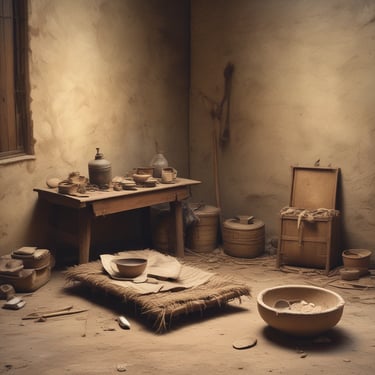
Their marriage was very humble. ‘Ali’s shield became the dowry; he sold what he had, and, with the Prophet’s guidance, the household was prepared with little. The wedding was celebrated simply. Guests ate dates and praised Allah. A companion later gifted them a land near the Prophet’s house so Fatima could be closer to him. They started their new life with simple furnishings: a bed, a pillow, a plate, a glass, a leather water bag, and a grinding stone.
Fatimah’s daily life at home was hard work. Despite fragile health, she ground flour until her hands were sore, carried water, and kept the household in order. She also served the community in times of conflict. She nursed the wounded after the battles and cared for those suffering. Once, when Ali suggested that she ask the Prophet ﷺ for a servant, the Prophet instead offered them something greater: the remembrance of Allah. He taught them to say Subhan-Allah 33 times, Alhamdulillah 33 times, and Allahu Akbar 34 times before sleep, saying that this is better than having a servant. They adopted this practice and never abandoned it. Ali (RA) later said, “By Allah, I never abandoned this advice, not even on the night of battle.”
Their marriage was loving and full of warmth. ‘Ali often recited poems to make Fatimah smile. They were blessed with four children: Hasan, Husayn, Zaynab and Umm Kulthum, each named by the Prophet ﷺ. The Prophet adored his grandchildren; he would play with them often. He called Hasan and Husayn “the leaders of the youth of Paradise.” Their household was small in means but filled with baraka.
The Final Days
Fatimah’s health had been fragile for years. The hardship of the boycott had physically weakened her. When Surat An-Nasr was revealed and the Prophet ﷺ understood that his mission on earth was entering its final stage, he told Fatimah that his time was near. Overcome with sorrow, she wept, but he immediately told her she would be the first among his family to join him. Those words comforted her and made her smile despite the grief. After his death, that grief never left her. Some narrations say that she never smiled again after his father passed away. She lived only about six months longer.
When Fatimah passed away, she was buried at night, privately, as she had requested, and laid to rest in Jannatul Baqi’. Her husband, ‘Ali (RA), was deeply grieved. Losing both the Prophet ﷺ and Fatimah in such a short time brought him profound sorrow for they were his two greatest loves.
The Prophet ﷺ described Fatimah (RA) as one of the women who perfected her faith, alongside Maryam, the daughter of ‘Imran and mother of Prophet ‘Isa (AS); Asiyah, the wife of Pharaoh; and Khadijah bint Khuwaylid (RA), her mother. He also said that Fatimah is “the leader of the women of Paradise.”
Conclusion
Fatimah (RA) lived close to the heart of the earliest Islam. She was raised in its trials, she served in its moments of need, and she loved its mission through every small act of care. Her home was rich in remembrance of Allah. Her body was weakened by the sacrifices she and her family made; that truth makes her endurance more human, and more noble. As a daughter, she was her father’s comfort; as a wife, she was her husband’s peace; and, as a mother, hers was the home through which the Prophet’s ﷺ blessed lineage continued.
In her story, we are reminded that the most beautiful lives are not those lived in ease and luxury, but those lived in service to Islam, to family, and to truth. As Allah says in the Qur’an:
“Wealth and children are the adornment of this worldly life, but the everlasting good deeds are far better with your Lord in reward and in hope.” (Surah Al-Kahf, 18:46)
Her story calls us to reflect:
How do we care for those who carry our community’s burdens?
How do we honor those whose lives are marked by sacrifices and unimaginable hardship?
And how do we respond when those we love are taken from us too soon?
May we be gathered with her, her father ﷺ, and her family in Jannah al-Firdaus.
Ameen.




Primary Sources
Abu Dawood, S. (n.d.). Sunan Abi Dawud, Hadith 5217. Retrieved from Sunan Abi Dawud 5217 - General Behavior (Kitab Al-Adab) - كتاب الأدب - Sunnah.com - Sayings and Teachings of Prophet Muhammad (صلى الله عليه و سلم)
Al-Bukhari, M. I. (n.d.). Sahih al-Bukhari, Hadith 3623, 3624. Retrieved from Sahih al-Bukhari 3623, 3624 - Virtues and Merits of the Prophet (pbuh) and his Companions - كتاب المناقب - Sunnah.com - Sayings and Teachings of Prophet Muhammad (صلى الله عليه و سلم)
Al-Bukhari, M. I. (n.d.). Sahih al-Bukhari, Hadith 5362. Retrieved from Sahih al-Bukhari 5362 - Supporting the Family - كتاب النفقات - Sunnah.com - Sayings and Teachings of Prophet Muhammad (صلى الله عليه و سلم)
The Qur’an. Translations and Tafsir references: Surah Al-Ahqaf (46:15). Retrieved from Surah Al-Ahqaf - 15 - Quran.com
The Qur’an. Translations and Tafsir references: Surah Al-Kahf (18:46). Retrieved from Surah Al-Kahf - 46 - Quran.com
Secondary Sources
Ghadanfar, M. A. (2012, January 13). Great Women of Islam Who Were Given the Good News of Paradise. DARUSSALAM Publishers & Distributors. Retrieved from Great Women of Islam : Mahmood Ahmad Ghadanfar : Free Download, Borrow, and Streaming : Internet Archive
Suleimane, O. (2020, January 30). Ali (ra) and Fatima (ra): From Love to the Pain of Death | The Firsts | Dr. Omar Suleiman. Yaqeen Institute. Retrieved from Ali (ra) and Fatima (ra): From Love to the Pain of Death | The Firsts | Dr. Omar Suleiman
Suleimane, O. (2020, February 3). The First Family: Ali (ra) and Fatima (ra) | The Firsts | Dr. Omar Suleiman. Yaqeen Institute. Retrieved from The First Family: Ali (ra) and Fatima (ra) | The Firsts | Dr. Omar Suleiman
Note:
All Qur’anic and Hadith references cited in this article are drawn from authentic and widely recognized Islamic sources. Interpretations are based on classical tafsir and contemporary scholarship for educational and reflective purposes.
References
Follow us
Contact
info@veil-vision.com
© 2025. Veil & Vision | All Rights Reserved | Visit our Policies